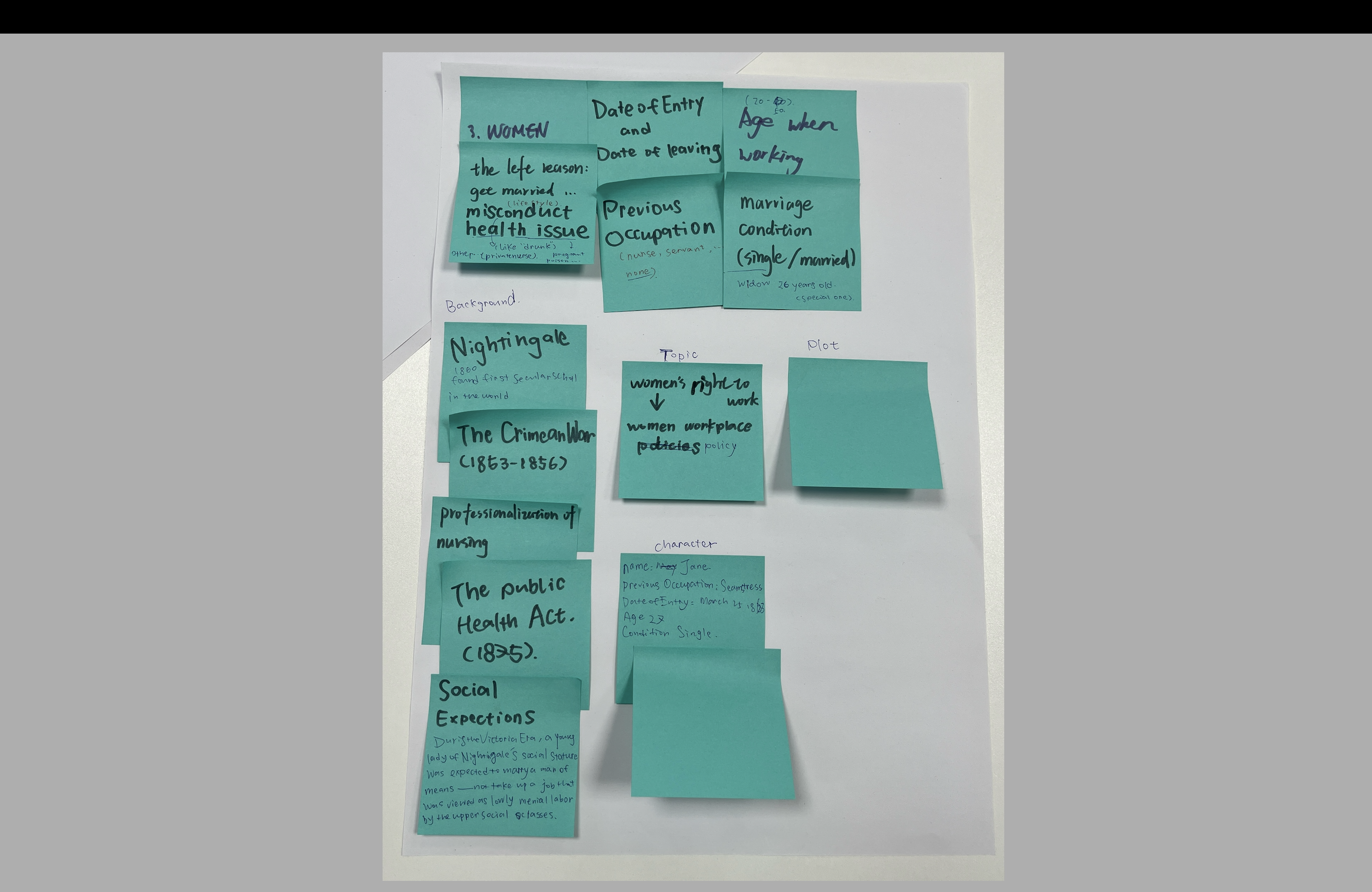
In this week, we used the historical data from the primary sources the Nurse Training Register: Private Records, and created a historical narrative based on the data we found. This activity helped me better understand how historical data can be recorded and generated while also presenting challenges such as missing information and misunderstanding.
Our group created a story about Jane, a 27-year-old former seamstress who joined a nursing training school in the Victorian era. Inspired by Florence Nightingale and the Public Health Act, Jane saw nursing as both a career opportunity and a way to contribute to society. Her daily routine involved attending classes, caring for patients, and writing in her diary. In her diary, she mentioned that a nurse lost her job due to alcohol consumption, which shows the strict discipline at work. This story is based on real training records, which is the primary source and we also used the information we found on Google.
Studying historical data allows us to see how society changes. For example, the medical reforms of the Victorian era reshaped professions like nursing. It also helps us understand how policies and cultural attitudes influence individuals’ lives. However, there are still many limitations when reading and adopting historical data. Many records are incomplete and hard to read, as they were handwriting. The Nurse Training Register provided names, ages, and training processes, illness but it also lacked some details. To fill these gaps, we relied on secondary sources about Victorian nursing history and the war. This exercise highlighted the role of data in shaping historical narratives.
Moreover, through this exercise, we explored the differences between primary and secondary data. Primary data, such as handwritten records, assisted us in creating the story of Jane, while secondary sources, like other online resources of Victorian nursing reforms, helped us to understand and complete her story, and make it reasonable. This highlighted a key challenge in historical research, the missing data and the need for interpretation. The historical data can't tell the full story, so we need to combine multiple sources and consider what information might be missing or misrepresented. Then, we can explain the history more accurately